The Lace-Up Ball Before the Modern Seam
Learn how to read a lace-up ball’s visible closure and panel joins, and separate what an image shows from what it cannot establish about construction.
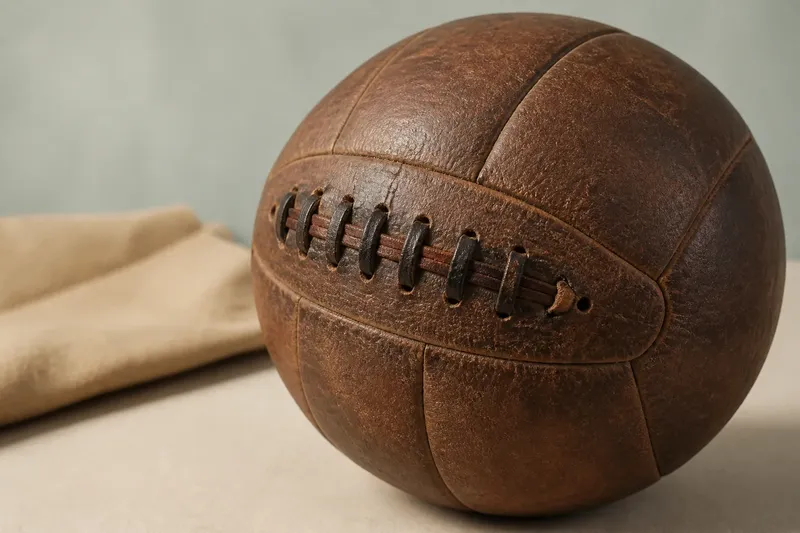
At a museum case, a dark strip across an old leather ball can catch your eye before its panel pattern does. That raised lace is a visible closure, and it offers a useful starting point for reading a lace-up ball without guessing at its age or performance.
A lace-up ball shows its closure on the surface
In a common lace-up construction, leather panels formed an outer casing around an inflatable bladder. An opening in the casing let the bladder be inserted, and a lace drew the opening’s edges together. The raised fastening made one part of the assembly conspicuous.
The lace was functional, not a decorative stripe. It marked where the casing had been closed and could make the surface look and feel different at that point. From a distance, a viewer might see a band across the ball; close up, the opening and fastening are more informative than the dark line alone.
A laced boot offers a simple comparison. Its laces pull separate edges together and remain visible as a fastening. The ball’s lace served a related closure function, though its purpose was to close a casing rather than secure footwear.
Panel joins and wear need to be read separately
Panel shapes and arrangements vary by design. A photograph may reveal the broad layout, but a worn surface, poor lighting, or an oblique view can hide where one piece ends and another begins. A visible line might be stitching, a seam, a shadow, or a mark left by use.
When looking at an object or a clear image, check the opening, the fastening, the panel edges, and any visible stitching as separate features. These observations can support a description of construction. They do not, on their own, establish the ball’s date, maker, competition, or behavior in play.
Wear can complicate the reading. Scuffs, darkening, and creases may cover an original join, while a lace can become flattened or irregular. The object’s present surface reflects both its construction and its later handling and storage.
Closures changed without making seams disappear
Ball designs do not follow one simple progression from exposed laces to invisible joins. Different constructions can use different ways to close a casing and connect panels. In some designs, a closure is visually prominent; in others, it is less distinct from the surrounding seams. The appearance of any particular ball should be described from its visible features rather than treated as proof of a universal historical sequence.
The casing and bladder are separate parts. The bladder holds air; the casing covers it and gives the ball its outer form. A change to the casing’s closure can alter the surface a viewer sees without changing the bladder’s basic role.
A ball without exposed laces still has joins between its casing pieces. The useful distinction is not “seams” versus “no seams,” but whether the closure stands out as a separate fastening or reads as one line among the panel joins.
How can you read a ball’s construction in an image?
What makes a ball visibly lace-up?
Look for an opening in the casing whose edges are drawn together by a visible lace. A dark line by itself could be a seam, shadow, or wear mark, so look for the fastening structure as well.
Does a ball without laces have no seams?
No. Its casing still consists of joined parts, though the joins may be less conspicuous than an exposed lace closure. Follow the panel boundaries rather than assuming that a smooth-looking surface is a single piece.
Can a photograph reveal how the ball played?
A photograph can show visible features such as panel layout, stitching, and a closure. It cannot establish how a particular ball felt or behaved in use from those details alone.
What can the lace tell you about a ball’s history?
It can help describe the visible construction, but it does not identify the maker, date, or sporting context by itself. For those claims, consult a reliable object label or maker information rather than relying on one feature.
A careful comparison keeps observation separate from inference
Imagine you are comparing two images: one shows a leather ball with a raised lace across an opening, while the other shows panel joins without an obvious fastening. First, record what each image actually shows: the first has an exposed closure, and the second has visible joins but no clear lace. Next, note image limits, such as shadow or a view that hides part of the surface. The resulting comparison can describe different visible construction, but it cannot establish which ball is older, how either handled, or whether they belong to the same design lineage.
- Observation: A lace visibly crosses an opening. If the edges are drawn together beneath it, then describe an exposed lace closure; otherwise call it a visible line until the fastening is clear.
- Observation: A dark mark has no visible lace or opening. If its structure remains unclear, then describe it as a dark line; otherwise identify the specific seam or fastening you can see.
- Observation: Panel boundaries meet at distinct edges. If the edges are visible, then describe their arrangement; otherwise avoid naming a panel pattern from the image.
- Observation: Stitching appears along a join. If the stitches are distinguishable, then note visible stitching; otherwise describe the join without inferring how it was made.
- Observation: Scuffs or creases cross a suspected seam. If wear obscures the boundary, then mark the construction as uncertain; otherwise describe the boundary that remains visible.
- Observation: A photograph cuts off part of the ball or hides it in shadow. If the closure cannot be seen, then seek another view or limit the description; otherwise record only the features visible in that image.
For a physical object, look at the whole ball before focusing on a single mark. Record the panel layout, closure, surface texture, and wear separately. If identification matters, compare those observations with the object’s label or maker information; a visible lace alone is not a date or provenance.
The phrase lace-up ball is most useful when it names a visible fastening rather than a guess about an object’s full history. Follow the opening and its edges first, then describe the panel joins around it. That small distinction lets a reader say what the surface shows while leaving unsupported claims out.